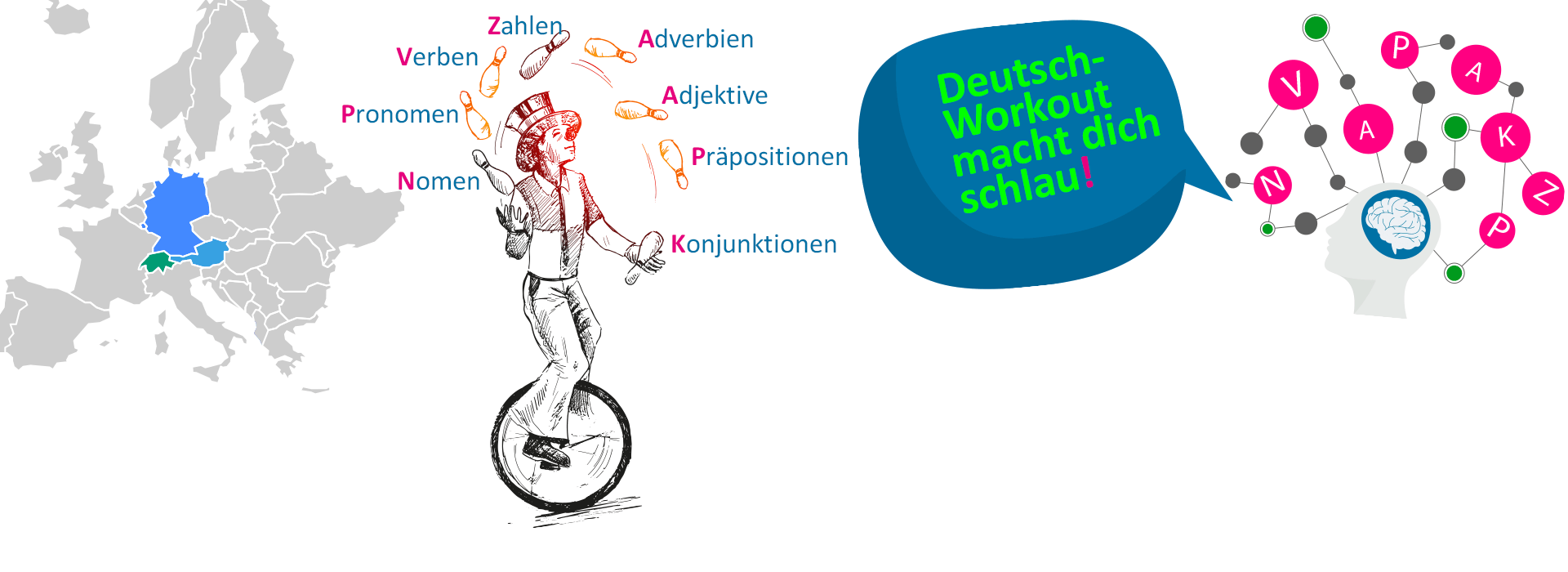
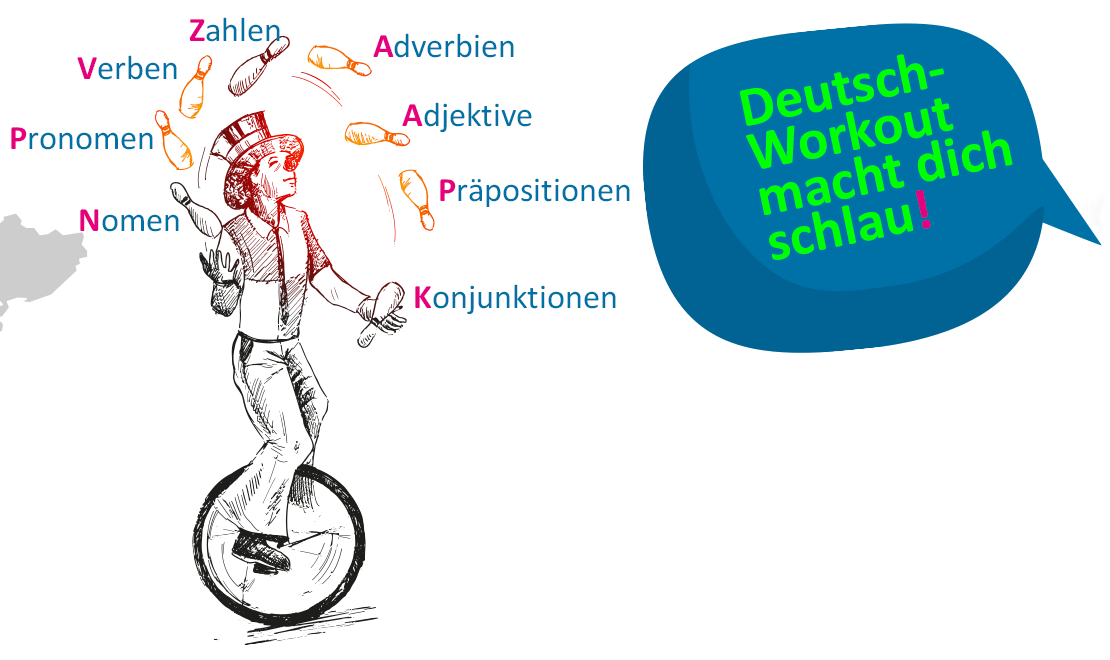
At B1 level, the functions of the parts of speech are expanded and you learn more ways of using and changing parts of speech. This page gives you an overview of the possibilities:
Verbs indicate the action in the sentence. Conjugated verbs in the main clause are in position 2.
From B1 language level, subordinate clauses and relative clauses are expanded and deepened.
The perfect vs. preterite, past perfect and future tenses I and II as well as passive sentences are discussed, applied and expanded.
More about verbs in levels B1-C1:
Nouns are names of phenomena, living beings, objects, plants, places and landscapes, etc. In German, fixed article genders with nouns and plural endings are learned.
From B1 language level onwards, word phrases and idioms are used more because the mental, social and cultural aspects of the language are conveyed first and foremost.
A brief overview of the endings of nouns and information on the gender of nouns is provided to help learners internalize them.
More about nouns in levels B1-C1:
Pronouns are words for addressing, addressing and replacing the nouns mentioned.
From B1 German language level, relative clauses and reflexive pronouns are used and expanded.
Demonstrative, indefinite and other pronouns are also used more frequently in German from B1 level onwards.
More about pronouns in levels B1-C1:
Adjectives express characteristics of a noun or subject in a sentence with the verb sein. Adjectives in German always come before nouns.
From B1 language level, the first and second participles are used as adjectives.
Otherwise, the formation of some adjectives from other word types is addressed.
More about adjectives in levels B1-C1:
Adverbs indicate the status or state of the action in the sentence if they are placed at the end of the sentence. If they come before a statement in the sentence, they strengthen the state of the statement.
Adverb pairs are discussed, treated and used from B1 German level onwards, although they have already appeared occasionally in German at A1 or A2 level.
More about adverbs in levels B1-C1:
Prepositions are connecting words for further explanations, clarifications and expansions in a sentence. There are prepositions with accusative, dative and alternating prepositions, later in B1 language level with genitive.
From B1 German level onwards, more genitive prepositions are learned.
Of course, what has been learned at A1 and A2 level (accusative, dative and alternating prepositions for temporal, modal and local information) must continue to be used, because the meaning of the prepositions remains unchanged, while their use becomes more complex and varied.
More about prepositions in levels B1-C1:
Conjunctions are connectors between sentences, parts of a sentence.
While the main clause conjunctions ADUSO (aber, denn, und, sondern, oder) are introduced at A1 level, connectors for subordinate clauses are discussed and expanded at A2 level.
From B1 language level, further subordinate clauses and thus subordinate conjunctions are introduced and learned.
More about conjunctions in levels B1-C1:
Interjections vs. particles are short exclamations.
Independent interjections stand alone and have a certain meaning, e.g. achso, ach, oh dear, herrje, naja, ja ja, oops, schade etc. Particles such as mal, doch, bitte are often used in the imperative to soften or strengthen the request.
From language level B1, there are several exclamations and interjections.
You can’t simply convey them without context or sound.
You will therefore pick them up quickly if you experience situations live and register them.
More about interjections in levels B1-C1:
For example, numbers determine the plural or singular form of verbs when they are connected to the subject and determine the articles and endings of nouns because of singular or plural.
Fractions are introduced and taught from A2 level.
From B1 level onwards, other applications of ordinal numbers, fractions, repetition, multiplication and division numbers are introduced.
Number words, which are also referred to as number pronouns elsewhere, are also addressed.
That was a brief overview of the typical parts of speech in German. If you would like to know more about certain word types, you can browse through our learning aids and find out more about them and other grammar topics. Have fun with it!