1. Verbs in subordinate clauses
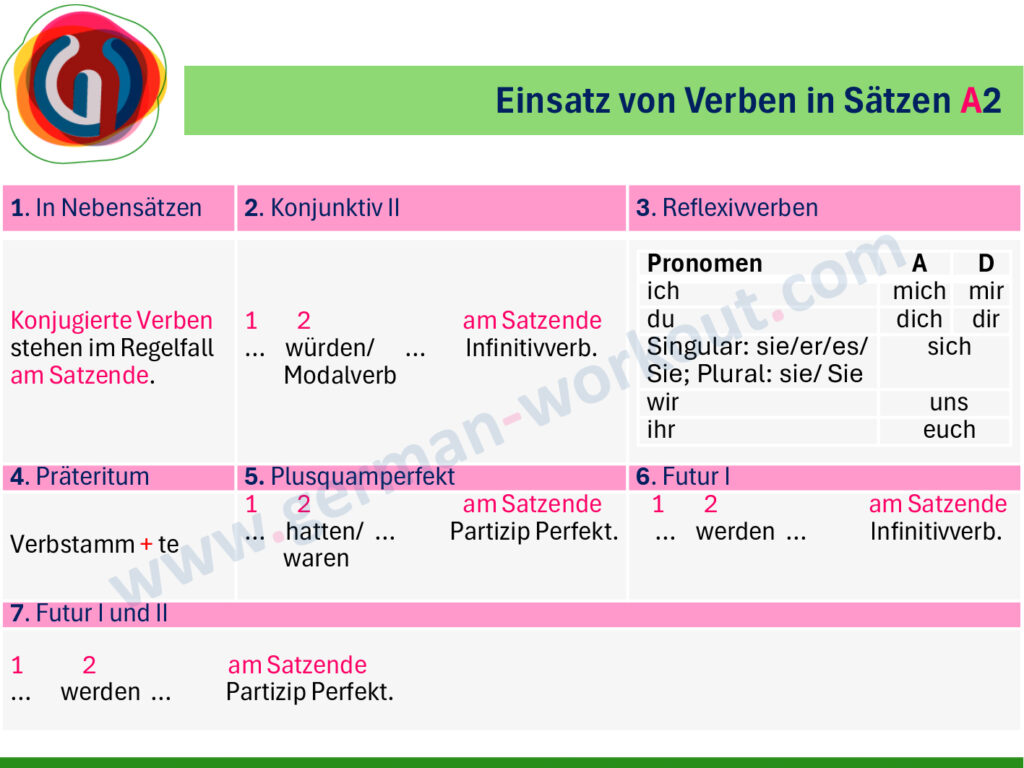
(dass, weil, obwohl usw.): Conjugated verbs in subordinate clauses always appear at the end of the sentence.
Example:
– Meine Uroma wünscht, dass sie zu ihrem 100. Geburtstag ein Rennrad bekommt, weil sie gern eine Fahrradtour damit machen kann.
– Viele Deutschlernende glauben, dass sie allein mit Hilfe von KI-Apps die deutsche Sprache beherrschen.
2. Verbs in the subjunctive II ( Konjunktiv II): “Konjunktiv II” is used to express causality. “würden” is the standard auxiliary verb. Sentences with modal verbs are conjugated according to the subjunctive II rule.
Example: Mich interessiert, was du sofort machen würdest, wenn du jetzt im Lotto gewinnen könntest? > Wenn es mir so etwas passieren würde, würde ich sofort eine Weltreise machen, weil ich mir schon immer wünsche, dass ich die ganze Welt ansehen möchte.
3. Reflexive verbs: Reflexive verbs take the place of a direct or indirect object in the sentence, emphasizing the subject. Where a verb would normally require an accusative object, it now takes the reflexive accusative pronoun in its place. The same applies to reflexive dative pronouns.
Example:
– Meine Mitbewohnerin erinnert sich gern an ihren letzten Urlaub, weil er sehr schön war.
– Die Geschwister von Elisa interessieren sich für die besten Filme bei der Berlinale sehr.
– Ich kann mir kein neues Fahrrad leisten, weil ich im Moment kaum verdiene.
4. Past tense (Präteritum): For narratives in fairy tales, history, reports and also for “modal verbs, sein, haben, werden” one uses verbs in the past tense to report something, that happened in the past.
Example:
– Als ich fünf Jahre alt war, ging ich bereits in die erste Klasse.
– Einmal vor etwa 30 Jahren stand dort auf dem Hügel ein kleines Häuschen, das einen sehr gepflegten Garten besaß, weil der Hausherr jede freie Minute mit den Gartenarbeiten verbrachte.
5. Past perfect (Plusquam-perfekt): This tense is used when dealing with a sequence of actions that take place before vs. after.
Example:
– Gestern bin ich einkaufen gegangen, nachdem ich von der Arbeit befreit gewesen war bzw. meine Arbeit erledigt hatte.
– Mein Cousin hatte zweimal Verspätungen bei der Bahn erlebt, bevor wir uns endlich getroffen haben.
6. Future I (Futur I): In German, if something is already a given in the future, the “Future I” tense is not used. It is reserved for expressions about „Prediction, assumption, request, promise“.
Example:
– Es ist zu dunkel jetzt. Ich glaube, dass es gleich tröpfeln wird.
– Ich schätze, dass ein Mitbewohner eines Tages in etwa zehn Jahren ein großer Chef von einem Biokonzern sein wird, weil er super gute Ideen über Verwaltungen, ebenfalls Chemieformeln hat und mega fleißig ist.
7. Passive sentences: Passive sentences are considered to be the opposite of active sentences, in which the subject is emphasized as the main actor for the action in the sentence.
In contrast, the influenced factor in the passive sentence is emphasized and the subject in the active sentence is ignored.
It is important to note that only the “accusative complement” can become a subject in the passive sentence.