Adverbs complement the meaning of adjectives and nouns when they come before them. If they complement the action in the sentence, i.e. the verb, they are placed at the end of the sentence. Most adjectives are also adverbs.
In this case, they differ only in their role in the sentence.
Adverbs are never declined and remain unchanged, whereas adjectives are always declined before nouns.
At A2 level, the information on adverbs is practiced specifically with the questions “when, why, how, where/wherefrom/where to“.
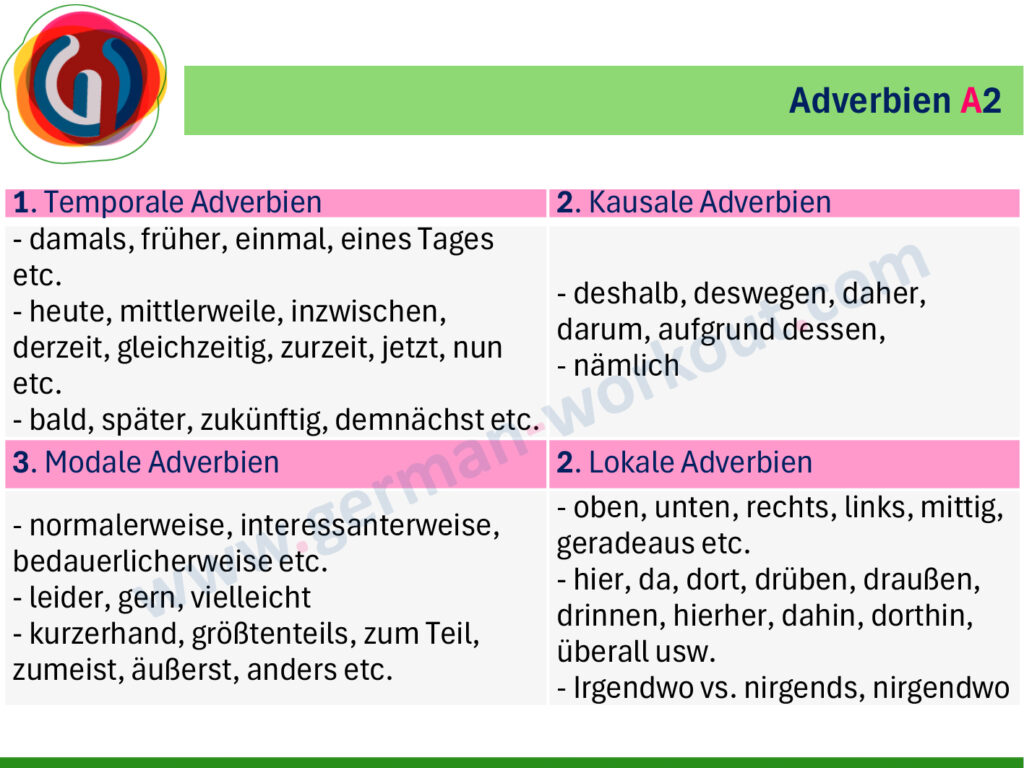
1. Temporal adverbs: They indicate time. At the A2 level, several tenses and temporal clauses are covered. Therefore, they are used selectively.
Example:
– Die Leute haben tagsüber keine Zeit, weil sie ganztags arbeiten müssen.
– Meine Eltern konnten damals viel verreisen, weil sie jung waren und Kraft für lange Reise hatten. Außerdem waren sie beide berufstätig und so konnten sie sich früher viel leisten.
– Sag mal, was willst du später machen? > Ich glaube, dass ich später nach meinem Studium erstmal einen Job suche. Nachdem ich einen Job bekommen habe, werde ich langsam an dem Plan mit der Weltreise beginnen.
2. Causal adverbs: They are used to express a consequence or a reason. They are also used to explain or justify one’s actions.
Example:
– Was ist los? Warum bist du so spät nach Hause? > Du weißt doch, dass die Straßen im Berufsverkehr eine Katastrophe sind. Daher komme ich wieder einmal spät nach Hause.
– Was ist passiert mit deinem Gesicht? > Ich bin nämlich gegen eine Straßenlampe gefahren.
3. Modal adverbs:They point to the manner, condition, or state of things or actions.
Example: – Wie willst du das Abendessen haben? > Ich hätte es gern romantisch und ganz ruhig.
– Wie sieht der Garten bei euch im Sommer aus? > Es sieht mega schön, wundervoll und grün aus, weil alles blüht und düftet.
4. Local adverbs:They provide information about a location, a place, or a direction.
Example:
– Hast du meine Schuhe irgendwo gesehen? > Tut mir leid. Ich sehe sie nirgendwo.
– Wo hast du wieder meine Sachen hingelegt? > Ich habe sie nicht angerührt. Aber sind die doch nicht drüben auf dem Sofa?
5. Conjunctive adverbs: They function as a conjunction and often appear in the main clause and at the beginning of the sentence, i.e., in position one.
Example:
– Du. Ich habe heute lange Besprechungen in der Firma. Deshalb komme ich heute erst spät nach Hause.
– Das kleine Mädchen hat gerade voll gefüttert. Trotzdem bittet sie ihre Mama jetzt um einen Becher mit drei Eiskugeln.